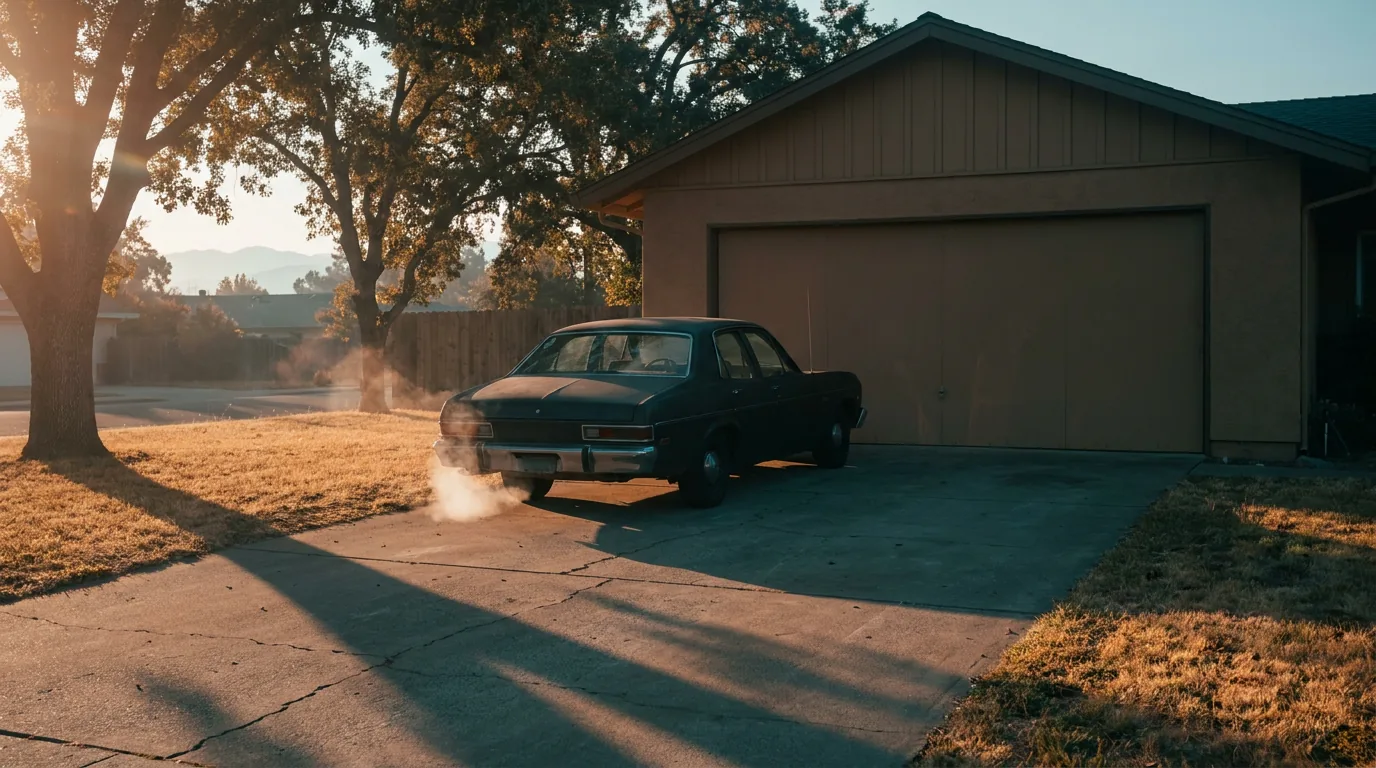
The first properly cold morning of the season usually turns up in early November. The windshield is fogged on the inside, the steering wheel is cold enough to notice, and somebody in the house does the sensible-looking thing. They open the garage door all the way, start the car, and go back to the kitchen for coffee while it warms up.
The door is open. Air is moving. It feels like the safe version of a habit everybody has been warned about.
It is not the safe version, and most of the reasons are about the garage rather than the car, which is why a garage door company is the one writing this.
What a cold engine actually puts out
The catalytic converter under a car is what turns most of the carbon monoxide in the exhaust into carbon dioxide, and it only does that well once it is hot. For the first few minutes after a cold start, before it reaches working temperature, the exhaust carries far more carbon monoxide than the same car puts out cruising down Highway 50.
So the warm-up is not a gentle version of driving. It is the dirtiest part of the trip, and it is happening in the one room that shares a wall with the house.
Carbon monoxide has no smell and no color. Nobody notices it collecting. The first signs are a headache, a bit of dizziness, or feeling oddly tired, and the person feeling them is usually not thinking about the car idling on the other side of the laundry room wall.
Why the open door does less than it looks
An open garage door is one big opening on one wall. A room with one opening does not ventilate the way a room with two does, because there is nothing pulling air through it. On a still November morning in the Valley, which describes a lot of them, exhaust does not leave in a tidy stream. It hangs.
Which way the car is parked matters less than people hope. Backed in, the tailpipe points at the back of the garage, which in many houses is the wall shared with the house. Nose in, it points at the opening, where the exhaust sits in the doorway and drifts back.
The CDC's guidance on this is one sentence long and does not make exceptions: never run a car or truck inside a garage attached to a house, even with the garage door open.
How it gets from the garage into the house
An attached garage is supposed to be separated from the house. Over thirty years of remodels, cable installs and a water heater swap or two, the separation is often less complete than the builder left it.
- The door into the house. It gets opened and closed all morning, and many of them seal far less tightly around the edges than the front door does.
- The furnace and its ducts. In a lot of houses around Sacramento and Elk Grove the furnace, the water heater or a run of ductwork sits in the garage. A leaky return duct out there can pull garage air into the air the whole house breathes.
- The holes nobody sees. Gaps around pipes, wiring and the attic hatch, and the hole somebody drilled for the internet cable in 2009.
The quiet car problem
There is a newer version of the same mistake that does not involve warming up at all. Cars with push-button ignition can be left running by accident. Pull into the garage, walk inside with the fob in your pocket, and on many cars the engine simply keeps going, quietly enough that nobody in the house hears it. Some newer cars warn you or shut themselves off after a while. Plenty of cars on the road do not.
People in this country have died exactly this way, in attached garages, with nobody aware the engine was on. It is worth one habit: listen for the engine, or look at the dash, before you close the car door.
Remote starters are the same mistake made from the kitchen. If the car lives in the garage, the remote start is for the days it is parked on the driveway.
What the opener can do to make it worse
If your opener has timer-to-close switched on, it has no idea there is a car running. It sees a door that has been open for a few minutes, flashes its light, beeps, and closes it. The garage door you opened to be careful is the one the opener shuts for you, with the engine still going and nobody in the garage to notice.
That is not a fault in the opener. It is doing exactly what it was asked to do. It is just one more reason the car should be on the other side of the door.
The money question
No prices, and very little money in either direction. Backing out and letting the car warm up on the driveway costs nothing. Many current owner's manuals suggest driving off gently after a short wait rather than idling at all, which costs less than nothing.
A carbon monoxide alarm is an inexpensive thing to buy. California law has required one since 2011 in single-family homes with an attached garage, a fireplace or a fuel-burning appliance, a description that fits a great many houses in Sacramento County. They also carry an end-of-life date, and an alarm past its date is a plastic disc on the ceiling.
What not to buy
- Do not buy a carbon monoxide alarm for the garage itself. Manufacturers generally tell you to keep them out of garages, where every cold start sets them off. It belongs inside the house, near the door from the garage and outside the bedrooms.
- Do not buy a garage exhaust fan as permission to idle. A fan helps with fumes from a car pulling in. It does not make a running engine in an attached garage a good idea.
- Do not buy an engine block heater. This is Sacramento. A November morning in the Valley is not the kind of cold those were made for.
The short version
Back out, close the garage door behind you, and let the car warm up on the driveway, or just drive it gently. Keep a working carbon monoxide alarm in the house near the garage door. If the car has push-button start, make sure it is off before you go inside.
This is the rare article where our whole recommendation is the car on one side of the garage door and the family on the other, and the door doing nothing at all. We can live with that.
Star Garage Door Repair · (833) 368-3891 · garagerepairstar.com
Lic. 1142048 · Serving Sacramento and the surrounding area.