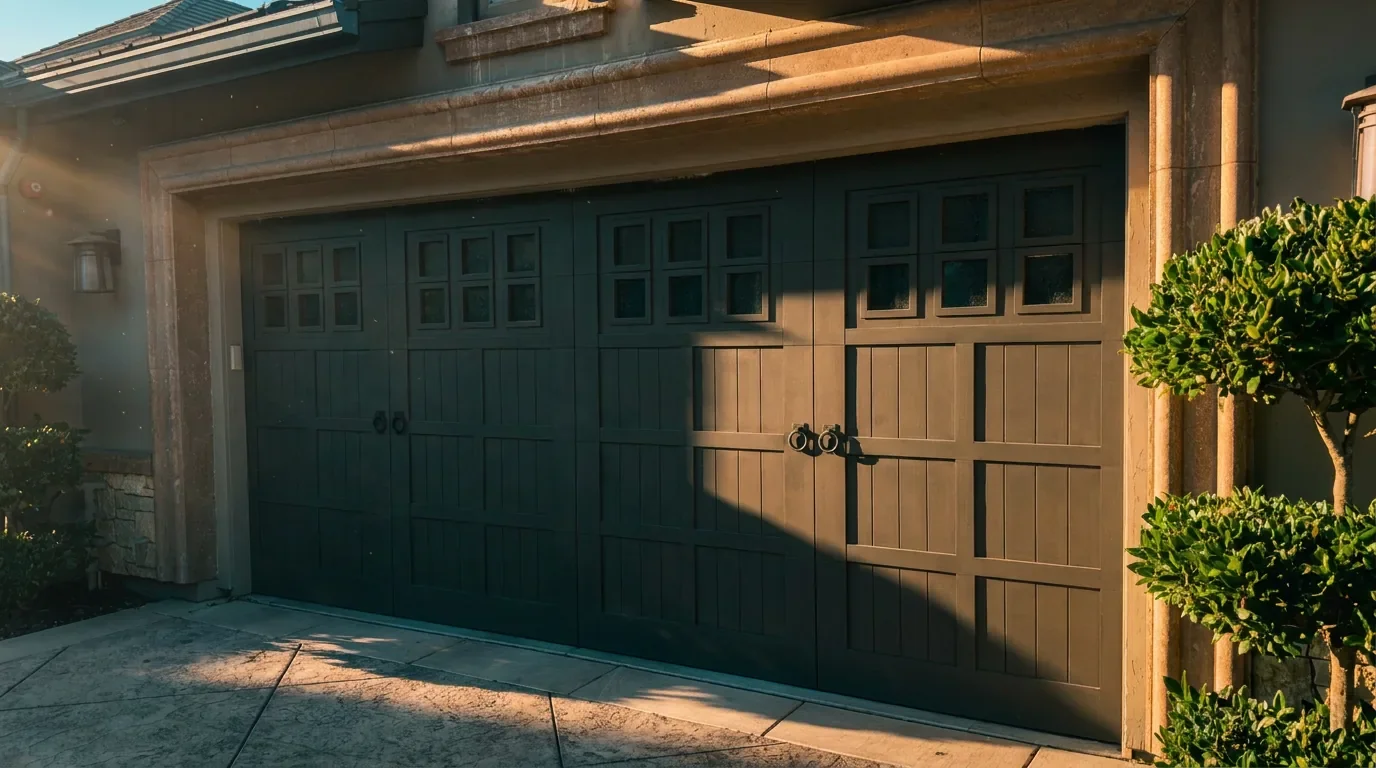
The door faces west. Every afternoon from May to September it took the full sun somewhere between two o'clock and sunset, and at some point this year somebody washing the car noticed that the left half of it is a slightly different colour from the right half, where the neighbour's tree throws a shadow.
Nothing is wrong with the door. It opens, it closes, it is quiet. It just looks tired, and the question that follows is whether it needs replacing or a weekend with a roller.
Usually it is the weekend. Here is how to make it work, and how to tell when it will not.
What is actually on the door now
Most steel sectional doors leave the factory galvanised, then primed, then finished with a baked-on topcoat, usually a polyester. That finish is thin, hard and very good at its job, and what the sun does to it over the years is not peeling. It is chalking.
Rub the flat of your hand across the sunny side of the door. If your palm comes away white or pale, that powder is the top of the finish breaking down under ultraviolet light. It is normal, it is why half the door looks faded, and it is the first thing to deal with before any paint goes on. New paint laid over chalk is paint laid over dust, and it will lift in sheets.
The other finishes are worth identifying before you buy anything:
- Plain painted steel. Paints well. This is the easy case.
- Embossed woodgrain steel. The texture is pressed into the metal, so it survives paint. It is still steel underneath.
- Printed or laminated wood-look finishes. The grain is an image, not a texture. Paint over it and it is gone for good, which is fine as long as you meant it.
- Real wood. A different job entirely. It wants stain or paint maintained on a schedule, bottom edge first, and many wood door warranties depend on that finish being kept up. Check yours before you change it.
Why October is the month to do it
Paint has opinions about temperature. The can will print a minimum, and it will also tell you, in smaller type, not to paint a surface in direct hot sun. A steel door facing west in a Sacramento August is well past what any label had in mind. The paint skins over before it levels, every roller pass leaves a lap mark, and the finish you get is the one you would expect from painting a frying pan.
October is usually dry here, the afternoons have stopped being ridiculous, and the rain generally does not settle in until later in the autumn. That window is the whole argument.
Even then, paint a west-facing door in the morning and an east-facing one after lunch, so the surface is in shade and cool to the touch.
The preparation, which is most of the job
- Wash it properly. Mild detergent, a soft brush, a thorough rinse, then a full day to dry. This is what removes the chalk. Do the hand test again afterwards.
- Scuff, do not strip. A light pass with a fine abrasive pad gives the new coat something to hold. You are not trying to reach bare metal.
- Treat any rust spot on its own. Take it back to clean metal, prime it with a primer meant for metal, and let that cure before the topcoat.
- Mask what must not be painted. The rubber bottom seal, the weatherstrip along the jambs and header, the rollers, hinges, tracks and any window glazing.
For the paint itself, most steel door makers' instructions call for an exterior acrylic latex rather than an oil-based enamel, and the door's own manual beats anything written here.
A roller for the flat faces and a brush for the recessed panel edges will do it. Two thin coats, not one heavy one.
The part people learn the hard way
A sectional door is not one surface. It is four or five panels hinged together, and every time it opens those joints fold. Paint the faces with the door closed, so they are flat, but keep the paint out of the gaps between sections, and leave it shut until it is properly dry. Paint that bridges a joint cracks the first time the door moves, in a neat straight line along every section, and you have painted a door with stripes.
The second lesson is about colour. A dark door in full sun gets considerably hotter than a light one, and some manufacturers limit dark colours, particularly on vinyl and composite doors, because the surface can get hot enough to distort. Charcoal looks wonderful in the sample. Read the manual before it goes on a door that faces the afternoon.
When paint is the wrong answer
Paint fixes how a door looks. It does not fix a door. If there is rust coming through from the inside of the bottom section, a panel creased where a bumper met it, or a door that has gone heavy and loud, paint will make a better-looking version of the same problem.
The honest test is this: if you would be happy with the door once it was the right colour, paint it. If you would still be annoyed by it, the paint is a delay.
The money question
No prices. A repaint is a materials-and-labour job, and the labour is almost all in the washing, scuffing and masking. Doing it yourself costs a weekend and a few cans. Having it painted costs more, and a professional finish on a door is worth it mainly where the door is the largest thing on the front of the house, which in a lot of Sacramento streets it is.
Replacing the door is a different order of cost altogether, and only worth it if something beyond the finish is wrong.
What not to buy
- Do not buy a new door because one side has faded. Fading is the finish, not the door.
- Do not buy an all-in-one paint and primer as a substitute for washing. No product bonds to chalk.
- Do not buy a spray rig for one door. The overspray will find the car, the windows and the neighbour's recycling bin.
- Do not buy paint for the rubber seals. They stay flexible only if they are left alone.
The short version
Wash off the chalk, scuff it, prime any bare metal, paint it closed on a cool morning, and leave it shut until it is dry.
It is a good job for a dry October weekend, it will make the house look newer than a lot of more expensive things would, and it does not involve us at all, which we have made our peace with.
Star Garage Door Repair · (833) 368-3891 · garagerepairstar.com
Lic. 1142048 · Serving Sacramento and the surrounding area.