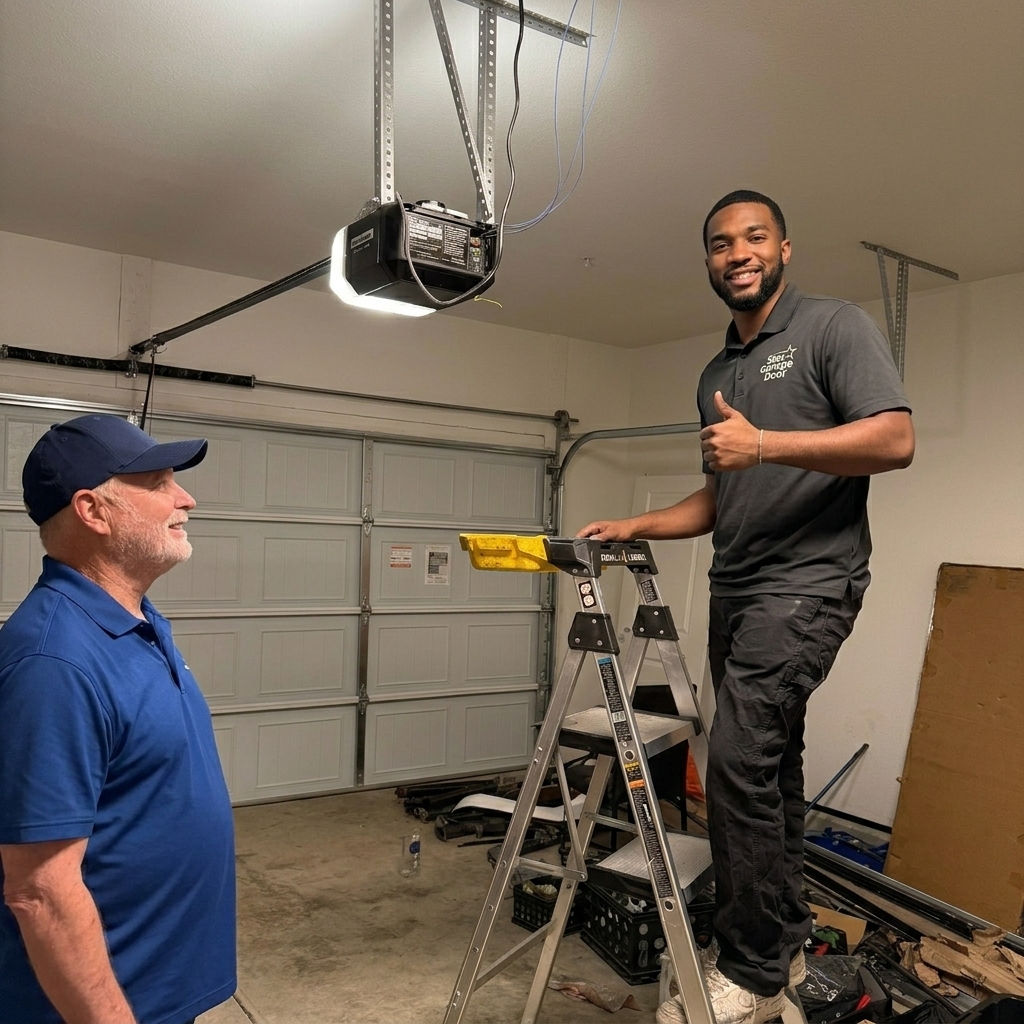
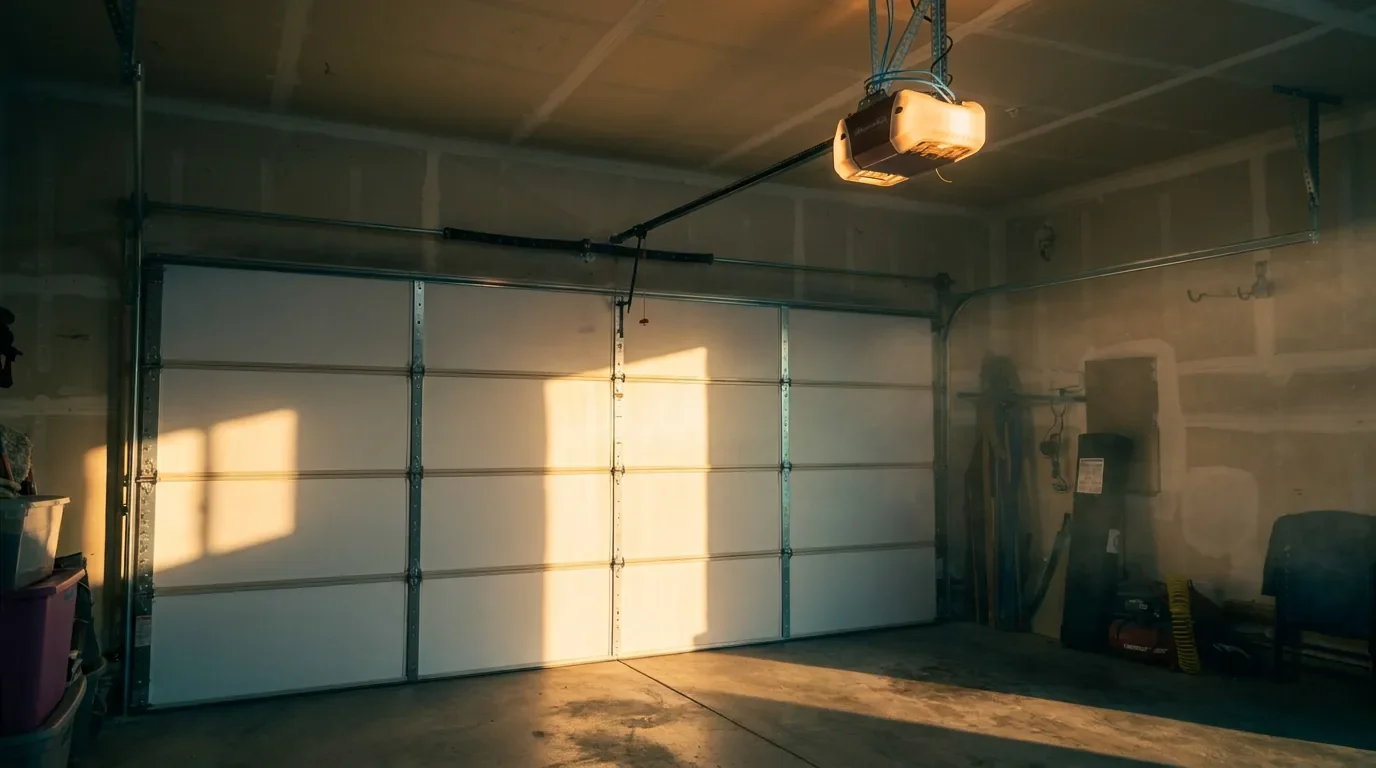
The new unit went in on a Tuesday. It is a belt drive, it was not cheap, and the installer was perfectly competent. On Wednesday morning the person in the bedroom above the garage heard the door open, and it sounded almost exactly like it did before.
This happens often enough that it is worth writing down properly. The opener is one noise source out of about five, and on a door that has done fifteen years it is rarely the loudest one.
Why the garage is such an efficient loudspeaker
Three things conspire.
The tracks are long, thin, formed steel, bolted rigidly to the framing of the house. Acoustically that is close to ideal for picking up a small vibration and radiating it. Anything that touches the track is coupled to your ceiling joists.
The door is a set of large, flat, thin steel panels. A flat panel is a diaphragm. Tap one and it rings.
The garage itself is a bare concrete box with hard walls and nothing soft in it, so nothing is absorbed. Everything reflects until it finds a wall shared with the house.
So a noise that would be trivial in a furnished room arrives upstairs at full strength, through the structure rather than the air. Which is also why shutting the bedroom door does nothing.
Identifying the sound
Stand inside the garage, close the door, and run it once while listening rather than watching. Each of these is distinctive once you are listening for it.
- A continuous scrape or squeal that rises and falls with the door's speed. Rollers. Specifically roller bearings that have failed or never existed, so the wheel is skidding in the track rather than rolling. This is the most common answer by a distance.
- A single sharp bang or clunk at the same point of travel every time. A hinge or a track joint. Something is stepping over a lip, or a hinge that has worn oval is taking up its slack all at once.
- A dry chirp or squeak, rhythmic, from the top of the opening. An end bearing plate. The torsion shaft turns in these and they are usually unsealed. One chirp per revolution.
- A deep rumble or shudder through the whole structure. Loose track brackets, or the horizontal track hangers not properly braced. The door is moving the framing.
- A rhythmic clatter that tracks the motor rather than the door. This one is genuinely the drive, and this is the only one on the list a new opener fixes.
- A grinding from inside the motor head. Drive gear. On a brand new opener, that is a warranty conversation.
The order to fix them in
Rollers first, always. They are the cheapest part on the door, they are the most common cause, and a full set of sealed-bearing nylon rollers changes the character of a garage more than any other single item. People routinely assume something was done to the opener.
Then hinges, if any are ovalled at the pivot. Then the end bearing plates, which are inexpensive and get skipped by nearly everyone. Then the track: brackets pulled up tight, alignment checked, tracks wiped clean.
Lubrication goes through all of it, in the four places that are actually bearings: roller bearings, hinge pivots, end bearings, and the spring coils. Not the tracks. Never the tracks. A greased track collects grit and turns into a grinding paste.
The one that is not about noise at all
Worth saying plainly: a door that has become louder over a season has not developed a personality. It has developed friction.
Friction is load. Load is heat in the opener motor, stress on the drive gear, and current through the logic board. A noisy door is a door that is shortening the life of the machine you just bought to make it quiet.
So this is not only an amenity question. The noise is the symptom that tells you the door is costing you the opener.
What the insulation of the ceiling will and will not do
People sometimes go at this from the room above: insulate the garage ceiling, add drywall, put a rug down upstairs.
That helps with airborne noise and does very little for structure-borne noise, which is the majority of what you are hearing. The vibration is travelling through the lag bolts into the joists, not through the air and up through the ceiling. Isolating the mounting of the opener rail and the track hangers with rubber does more than a foot of insulation.
The money question
No prices, but the ranking here is unusually favourable to the homeowner, because the cheapest items are the ones that work.
A full set of good rollers and a proper lubrication is the least expensive intervention available and the most effective. Hinges are similarly modest. End bearings are a small part with a slightly more involved fitting, because the shaft has to be supported. Track work is labour rather than parts. Rubber isolation at the hangers is pennies.
The most expensive thing on the list is the opener, and it is the thing that was already bought.
What not to buy
- Do not buy a second opener. If the first quiet one did not fix it, the second one will not either.
- Do not buy nylon rollers with no bearing. The material on the outside is not what makes a roller quiet. The bearing count is on the box.
- Do not buy a noise-dampening kit before checking the rollers. Isolators are a real and useful product and they are the second step, not the first.
- Do not let anybody grease the tracks to quiet them. It works for about two weeks and then makes everything worse permanently.
The short version
The opener was one of five noises and usually not the loud one. The loud one is ten small wheels that cost less than the trim on the opener you bought.
We do have to tell people this after they have already spent the money, which is an awkward conversation and a small invoice. Better than selling a second opener.
Star Garage Door Repair · (833) 368-3891 · garagerepairstar.com
Lic. 1142048 · Serving Sacramento and the surrounding area.