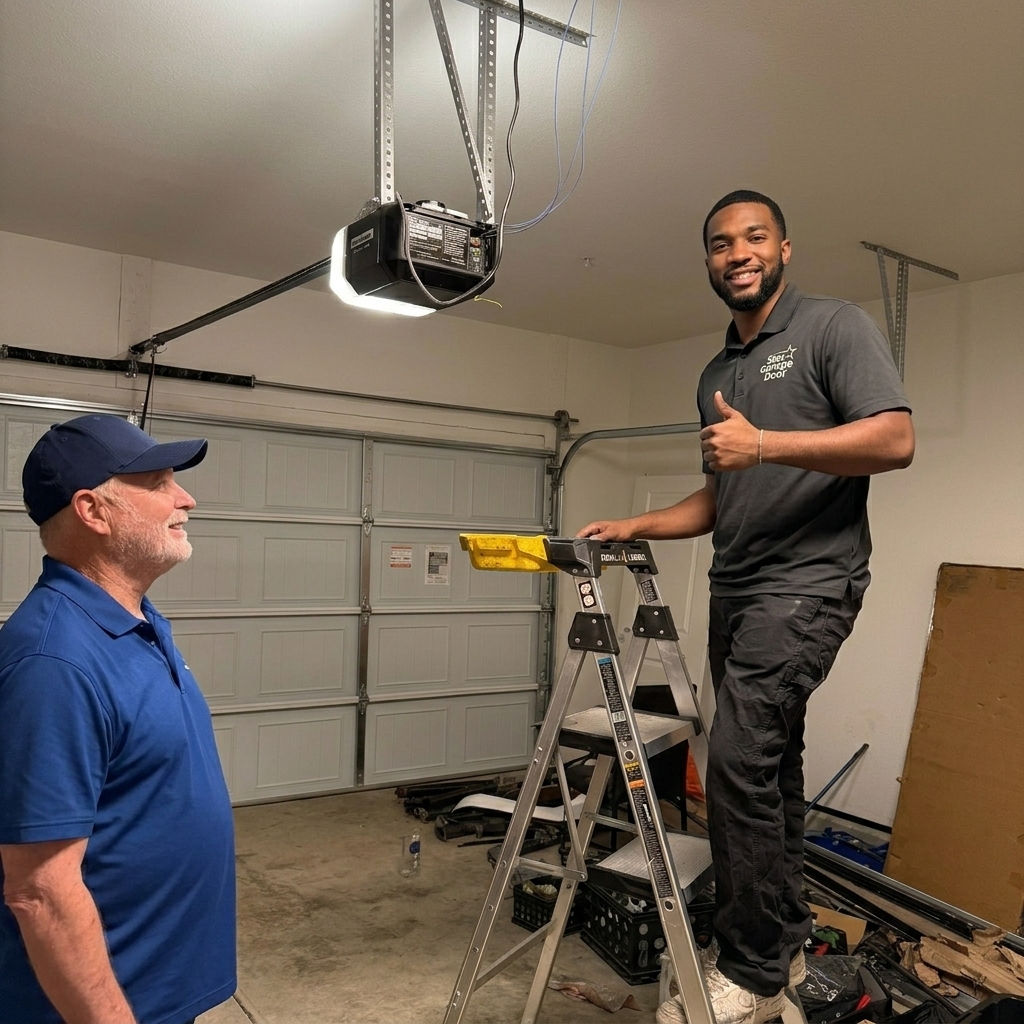
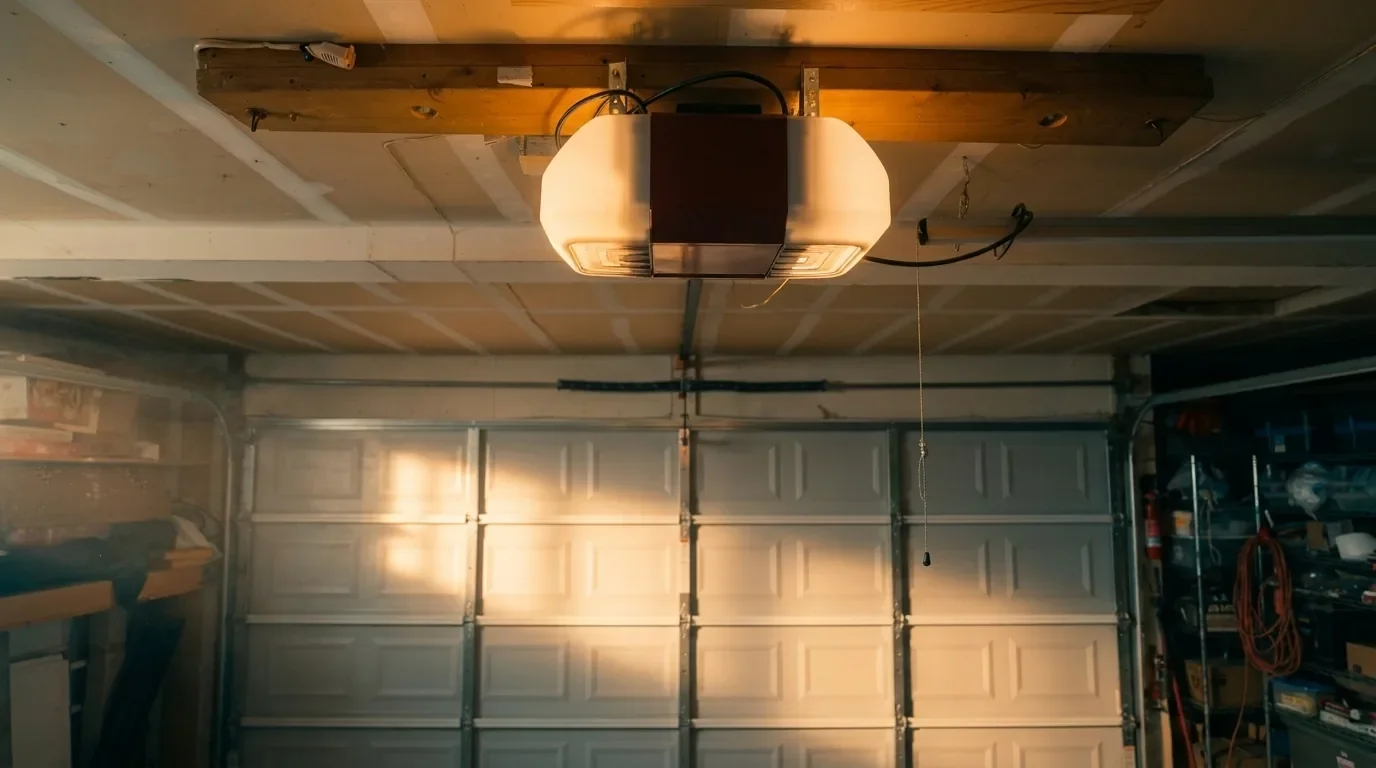
The number people repeat is ten to fifteen years, and it is a reasonable average in the way that any average over a machine with three separate wear-out mechanisms is reasonable. It is not much use for deciding what to do with the one in your garage.
A more useful framing: openers do not die. Three specific parts fail, on different schedules, and two of them are repairs.
Part one: the drive gear
Inside the motor head of most chain and belt openers is a plastic worm gear driven by the motor shaft. Plastic sounds like a cost-cutting choice and it is not. It is a deliberate weak point, chosen so that when the drivetrain is overloaded, the cheap gear strips rather than the motor burning out or the rail bending.
The symptom is unmistakable once you have heard it: the motor runs perfectly, at normal speed and normal sound, and nothing moves. Often with a grinding note underneath.
Here is the part that matters. A stripped drive gear is a symptom of overload, and the overload almost always came from the door, not from the opener. A door with tired springs, a dragging roller or a binding track makes the opener work several times harder than it was designed to, and eventually the designed weak point does its job.
So replacing a stripped gear without checking the balance of the door is buying the same repair again on a schedule. The gear and sprocket kit is inexpensive and widely available. The balance test is free.
Part two: the capacitor
The motor in most residential openers is a single-phase AC motor, and that type cannot start on its own. It needs a capacitor to create the phase shift that gets it turning. Capacitors age, and heat ages them faster, which is relevant in any garage that spends August above 100 degrees.
The symptom is a hum with no rotation, or a motor that starts sluggishly and sometimes not at all. It often appears first on the coldest morning of the year and gets steadily more frequent.
A capacitor is one of the least expensive parts in the machine. It is also mains-connected and stores charge after the unit is unplugged, which is why this particular repair is not a homeowner job even though it looks like one.
Part three: the logic board
This is the one that ends openers.
The board carries the receiver, the safety sensor circuit, the travel limits, the force sensing and the relays. It fails from heat, from surges, and from twenty years of thermal cycling working solder joints loose. Sacramento gives it all three.
Symptoms are the erratic ones: intermittent operation, lights behaving oddly, the door reversing at random points with clean sensors and a well-balanced door, the unit responding to the wall button but not to any radio.
A board is the most expensive part in the opener, and on an older unit its cost starts to be a real fraction of a new machine. That is the honest decision point, and there are three things worth weighing besides the number.
When repairing genuinely stops making sense
- Availability. Boards for discontinued models get scarce, then get expensive, then stop existing. If a board is hard to source now, the next failure has no answer.
- The safety generation. Openers made before the early nineties predate the requirement for photo eyes. If your opener has no sensors at the bottom of the tracks, that is not a vintage machine, that is a door that will close on whatever is under it. Replace it.
- What else it does not have. Rolling codes, a proper manual release, a battery backup option. On a unit old enough to lack rolling codes, the security argument alone is usually decisive.
Against that, an opener from the last fifteen years with an available board, working sensors and a healthy motor is a machine worth keeping. They are simple and they are durable when the door they are attached to is behaving.
What actually shortens an opener's life
Almost entirely one thing: the condition of the door.
Every additional pound the opener has to pull is heat in the motor, load on the gear and current through the board. A door that is out of balance by fifty pounds does not mildly inconvenience the opener, it doubles its working load. We have seen ten-year-old openers in better condition than five-year-old ones for no reason other than that somebody kept the springs and rollers right.
The second factor is duty cycle. A household that opens the door twelve times a day is running four times the cycles of one that opens it three times, and no opener is rated in years.
The money question
No prices, but the ladder is clear and worth carrying in your head. A capacitor is the cheapest. A gear and sprocket kit is next, and both are ordinary repairs on a good machine. A logic board is a large step up and is the point at which the arithmetic changes. A new opener, installed, is a category above that, and the installation is a real part of it if the header, the wiring or the sensor runs need work.
What not to buy
- Do not buy an opener because the gear stripped. That is a part and an hour, plus a balance check that is more important than either.
- Do not buy a board for a pre-sensor opener. Money spent keeping an opener with no photo eyes running is money spent on the wrong thing.
- Do not buy the highest horsepower on offer. If a standard unit cannot move your door, the door is the problem and a bigger motor hides it until something worse happens.
- Do not buy a new opener without the door being checked first. A new opener on an unbalanced door is a new opener with a shortened life, and you will have paid to find that out.
The short version
Gear, capacitor, board. Two are repairs and one is usually the end. What decides how soon you meet the third is almost entirely how well the door is looked after, which is not a fact about the opener at all.
It does mean a good share of our opener calls end with a small part and a spring adjustment rather than a new machine on the invoice. That is the correct outcome, even though it is not the profitable one.
Star Garage Door Repair · (833) 368-3891 · garagerepairstar.com
Lic. 1142048 · Serving Sacramento and the surrounding area.