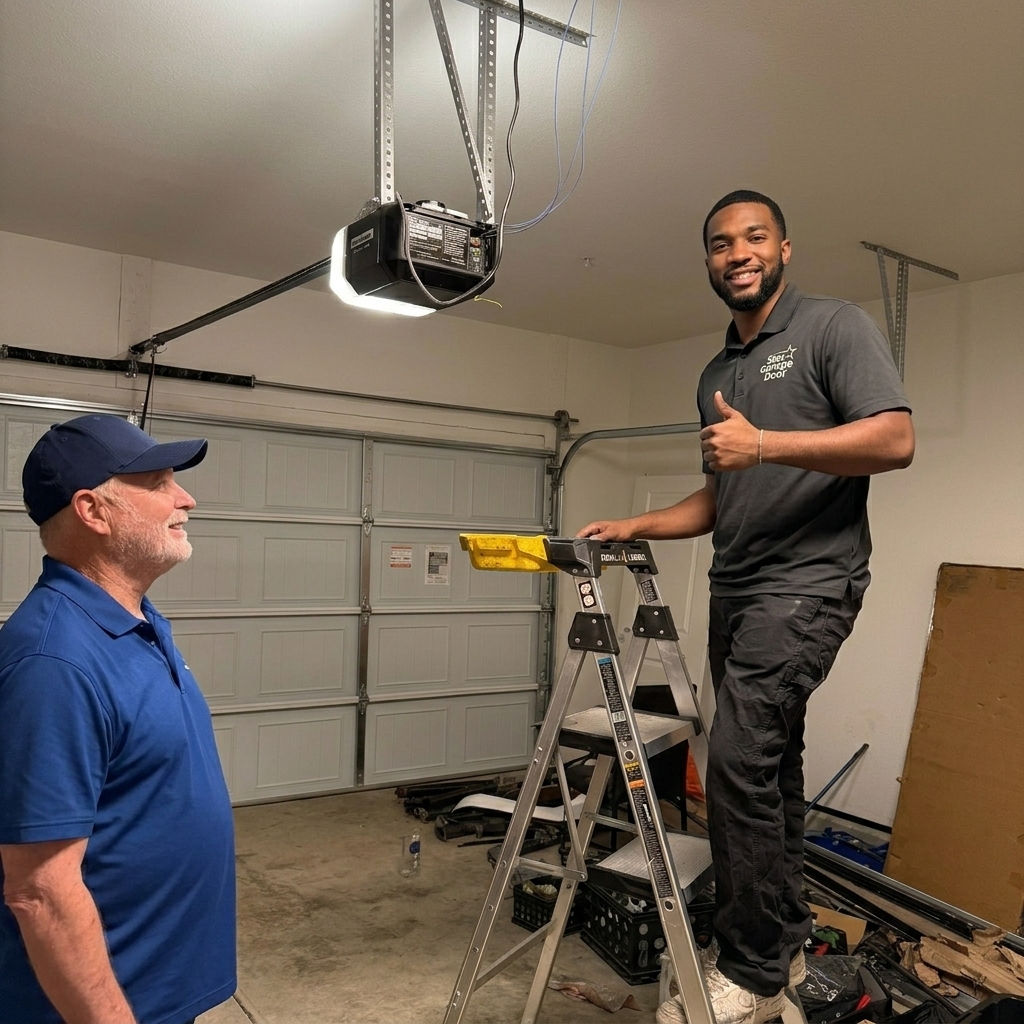
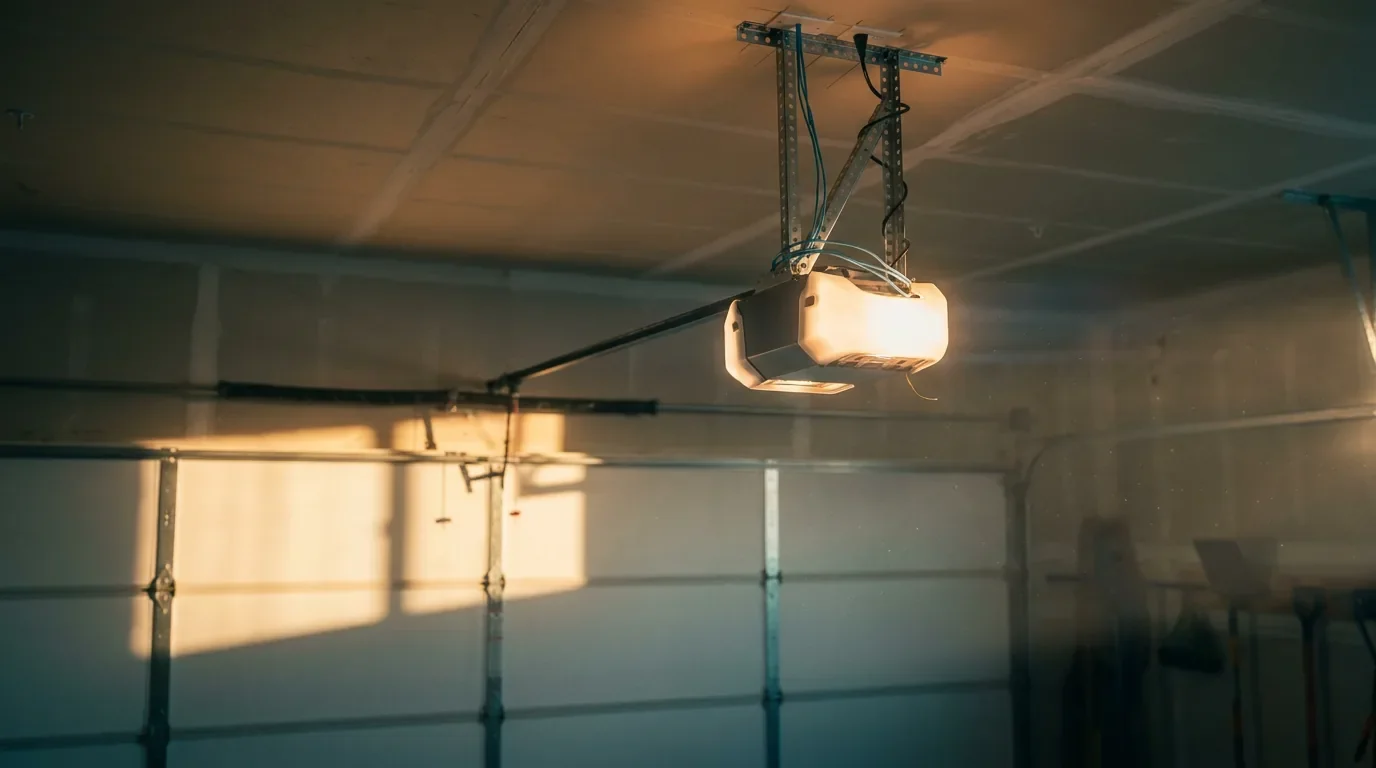
The door is sixteen feet of steel sections on a track, pulled shut by a motor and held there by a gearbox that will not back-drive. Nobody is lifting it from the driveway. Which is why, when a garage in Rosemont or Citrus Heights does get opened by someone who does not live there, it is almost never the door that let them in.
It is nearly always one of a short list of things around the door, and most of them cost very little to close.
None of them involve buying a new door, which is a sentence we seem to be obliged to keep writing.
What actually holds a garage door shut
On a door with an opener, the lock is the opener itself. The trolley on the rail is connected to the door by an arm, and the drive, whether chain, belt or screw, will not turn unless the motor turns it. Push up on a closed door and you are trying to drive the gearbox backwards. That is a strong lock.
It has exactly two ways round it. You can tell the motor to run, which is what a remote, a keypad or an app does. Or you can disconnect the door from the trolley, which is what the red emergency release cord does. Every realistic way into a closed garage goes through one of those two.
The remote in the car
This is one of the most common ways in. A car parked on the driveway overnight has a garage remote clipped to the visor and, in the glovebox, a registration with the address on it. Break a window, press the button, and the house has opened itself.
- Park inside, or take the remote in. A keychain remote goes wherever the keys go, which is into the house.
- Use the lock button on the wall control. Many wall controls have a lock or vacation setting that stops every handheld remote working until you turn it off. It costs nothing and most people have never pressed it.
- Delete remotes you cannot account for. A remote from the previous owner, the one lent to a contractor, the one that went missing with a car you sold. Clearing the opener's memory and re-pairing the ones you have is ten minutes.
The hook over the top
This one is well known and it works because the emergency release is designed to be easy to pull. Push the top of a closed door inward slightly and there is a gap at the header. A length of stiff wire with a hook on the end goes through that gap, finds the release cord or its lever, and pulls. The door is now disconnected from the opener and lifts by hand.
The fix is to make the release hard to reach from outside while keeping it easy from inside, because the release is a safety device and it has to work when the power is out.
- Shorten the cord. It needs to hang where an adult can reach it, not down to the top of the door.
- Fit a release shield. A small cover over the release lever that a hook cannot get behind. Inexpensive and made for exactly this.
- Do not tie the release shut. A release you cannot operate in an emergency is worse than the problem it was meant to solve.
The keypad and the old opener
A keypad with a code of 1234, or the last four digits of the house number, is a sign on the wall. So is a keypad whose most-used buttons are worn shiny while the rest are not. Change the code, and change it again if the membrane shows which keys you press.
Openers made before the later nineties are the other quiet risk. They sent the same fixed code every time, set by a row of small switches, and anyone with the right equipment or enough patience could copy it.
Most openers since then use rolling codes, which change with every press. If yours still has those switches, that is one of the few honest reasons to replace a machine that works perfectly.
The door into the house
This is the one that matters most and gets looked at least. The garage is not usually the target. The house is, and the door between them is often a hollow-core interior door with a privacy latch, on the assumption that the garage door is the real barrier.
Treat it as an exterior door. A solid door, a deadbolt, and the habit of locking it at night do more for security than anything you can do to the garage door itself.
The same goes for the side door into the garage from the yard, if there is one. It is usually the original builder's lockset, it is out of sight of the street, and nobody has thought about it since the house was new.
The money question
No prices. Most of what is in this article is free: pressing the lock button, clearing remote memory, changing a code, shortening a cord, bringing the remote inside. A release shield and a keychain remote are small parts. The expensive items on the list are replacing a fixed-code opener and fitting a proper door into the house, and both are worth doing when they are genuinely the gap.
What not to buy
- Do not buy a new garage door for security. A closed door on a working opener is already the strongest thing on this list.
- Do not add a manual slide bolt to a door that has an opener. One day somebody presses the button with the bolt thrown, and the motor tries to lift a locked door. The top section loses.
- Do not buy a smart opener as a lock. An alert that the door is open is useful. It does not stop the remote in the car opening it.
- Do not buy an alarm for the garage before you fit a deadbolt on the door into the house.
The short version
Take the remote out of the car, press the lock button, shield the release, change the keypad code, and put a real lock on the door into the house.
Four of those five you can do tonight without calling anybody, and the fifth is a locksmith, not us. We are aware this is not how a garage door company is supposed to write about security.
Star Garage Door Repair · (833) 368-3891 · garagerepairstar.com
Lic. 1142048 · Serving Sacramento and the surrounding area.