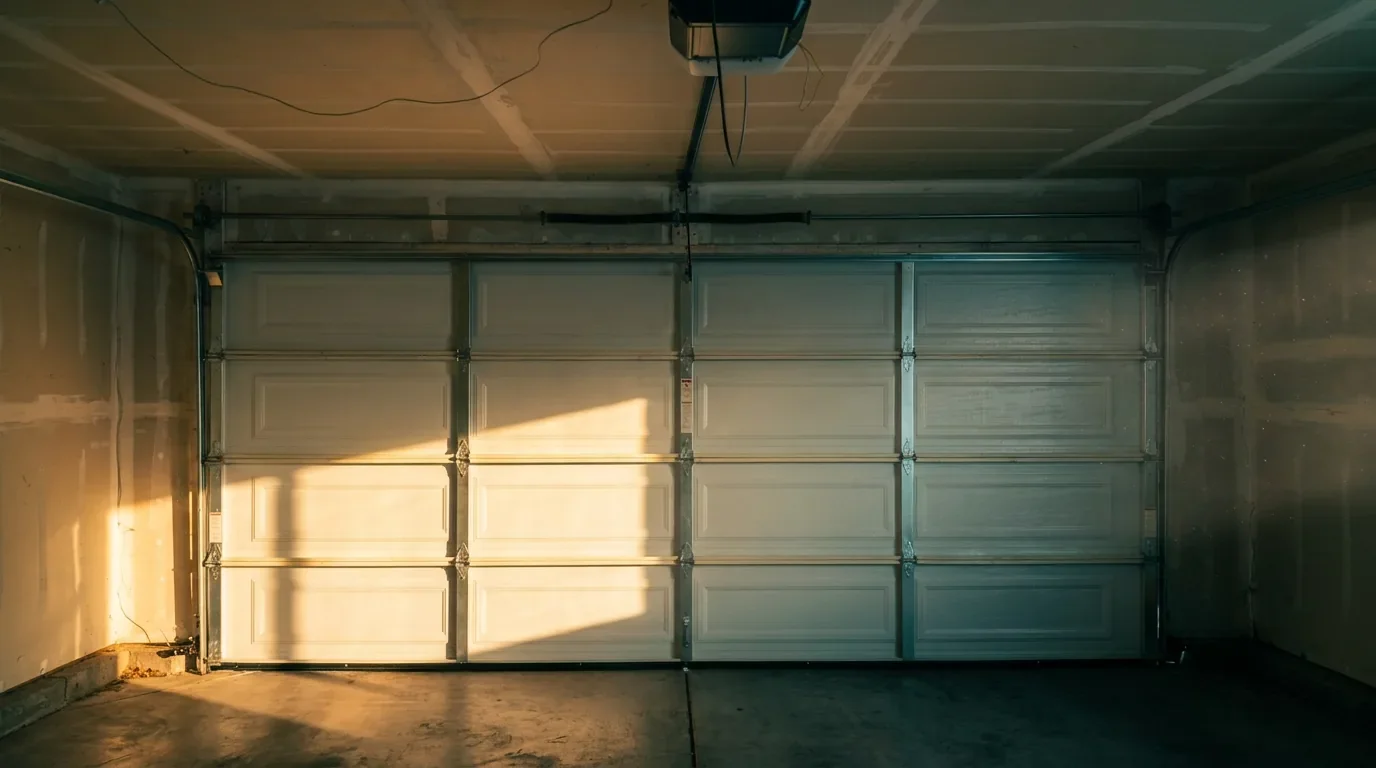
Someone stands in their garage in the third week of August, at four in the afternoon, and decides that this cannot be allowed to continue. The garage is well past 100 degrees, the wall it shares with the house is warm to the touch, and the air conditioning has been running since ten.
The insulated door is the obvious purchase, and it is often the right one. It is also routinely oversold on the wrong number, and it has a mechanical consequence nobody mentions at the point of sale.
What R-value is, and why the sticker overstates it
R-value measures resistance to heat flow through a material. Higher is better, and the scale is not linear in usefulness: the jump from nothing to a little is enormous, and the jump from a lot to more is small.
The problem with the number on a garage door is that it usually describes the panel, not the door. A door is not a continuous slab of foam. It has section joints, an end stile at each side, a perimeter, and a bottom seal. Heat and air move through all of those, and none of them are in the panel's R-value.
Two doors quoting the same R-value can perform quite differently depending on how the sections are constructed and how well the perimeter is sealed. Which leads to the honest version of the advice.
The number that matters more here is air, not R
In a Sacramento summer, a garage gets hot by two routes: conduction through the door, and air exchange around it. The second is bigger than most people expect.
An old, uninsulated door with a perished bottom seal, gaps at the jambs and daylight visible at the top corners is exchanging hot outside air with the garage continuously. You can have all the R-value you like in the panel and it will not touch that.
So the sequence that gets the best result per pound spent, in order:
- The bottom seal. The single cheapest thermal improvement available, and it is also what keeps dust, water and rodents out. A U-shaped astragal in a retainer, replaced when it goes hard.
- The perimeter stop moulding. The vinyl strip on the jambs and header that the door closes against. It perishes in the sun and stops touching the door, and it is inexpensive to replace.
- Then the panel insulation, which is the door itself.
Doing the third without the first two is the most common way to be disappointed by an expensive door.
The three constructions, honestly
- Single-skin steel. One layer of steel, no insulation, no back. Light, inexpensive, drums loudly, and offers essentially nothing thermally. The default on a lot of builder-installed doors.
- Polystyrene-filled. Cut foam board pressed into the back of the panel, sometimes with a thin vinyl backer. A real improvement, moderate weight gain. The foam is not bonded across its whole face, so it adds less stiffness than the next option.
- Polyurethane, injected. Foam injected between the front and back skins and expanded in place, bonding to both. Best R per inch, and structurally it turns the panel into a composite. Noticeably more rigid and much quieter. The heaviest, and the most expensive.
That last property, rigidity, is underrated. A polyurethane door resists denting, resists racking, and does not drum. Several of the reasons people like them have nothing to do with temperature.
The consequence nobody mentions
Insulation is weight. A single-skin steel door might be 130 pounds. A comparable insulated double can be well past 300.
The springs above your opening are wound to counterbalance a specific weight. That is the entire job they do. Add sixty or a hundred pounds to the door and the springs are now under-sprung for it, which means:
- The door is heavy to lift by hand and drops if you let go halfway.
- The opener is carrying the difference, every cycle, which is what strips drive gears.
- The safety reversal is compromised, because the opener's force setting has to be raised to cope.
This is fine when the door and the springs arrive together, calculated for each other. It is not fine when somebody insulates an existing door with a retrofit kit and nobody recalculates. We find doors that have been quietly overloaded for years by a well-meant improvement, and the tell is always the same: the opener has been struggling and everybody blamed the opener.
The money question
No prices. What sets the number is construction first, size second, and glazing third. Polyurethane costs more than polystyrene which costs more than nothing, at every size. A sixteen-foot double costs more than two singles' worth of anything. Windows cost more than panels and reduce the thermal performance you were buying.
What is genuinely cheap is the seal and the stop moulding, and they should be done first regardless of what else happens.
What not to buy
- Do not buy R-value for an unconditioned, detached garage. If you are not cooling that space and it does not share a wall with a room, you are insulating the outdoors. The seals still make sense; the panel does not.
- Do not buy a retrofit insulation kit without a spring recalculation. The kit is cheap and the consequence is not.
- Do not buy the highest R-value on the shelf as a default. Above a certain point on a garage door you are paying for a number that the joints and the perimeter are already undermining.
- Do not buy windows and expect the thermal result of the brochure. Glazing is the weakest part of any door. It can be worth it for light. It is not worth it for heat.
The short version
Seal the gaps, then insulate the panel, and make sure whoever hangs a heavier door has done the arithmetic on the springs.
The first of those three costs the least and does a surprising amount, which does mean the most useful visit we make about a hot garage often ends with a strip of rubber and no door sale at all.
Star Garage Door Repair · (833) 368-3891 · garagerepairstar.com
Lic. 1142048 · Serving Sacramento and the surrounding area.