The person who cares about this is almost never the person who parks in the garage. It is whoever sleeps in the room above it, and they have usually been quietly building a case for months before anyone calls us.
The belt opener is the standard answer, and it is often the right one. It is worth knowing what it is actually solving, because in a decent share of Sacramento houses it solves a problem the homeowner does not have and leaves the one they do.
What the drive actually does
The opener does not lift your door. This surprises people, so it is worth being firm about it: the springs lift the door. The springs are storing enough energy to counterbalance the entire weight of it, and on a properly balanced door you can raise it with one hand.
The opener's job is to overcome friction, provide the last bit of push, hold the door where it is, and stop it if something is in the way. It is a small motor doing a small amount of work, which is why a 140-pound door is moved by something you could carry under one arm.
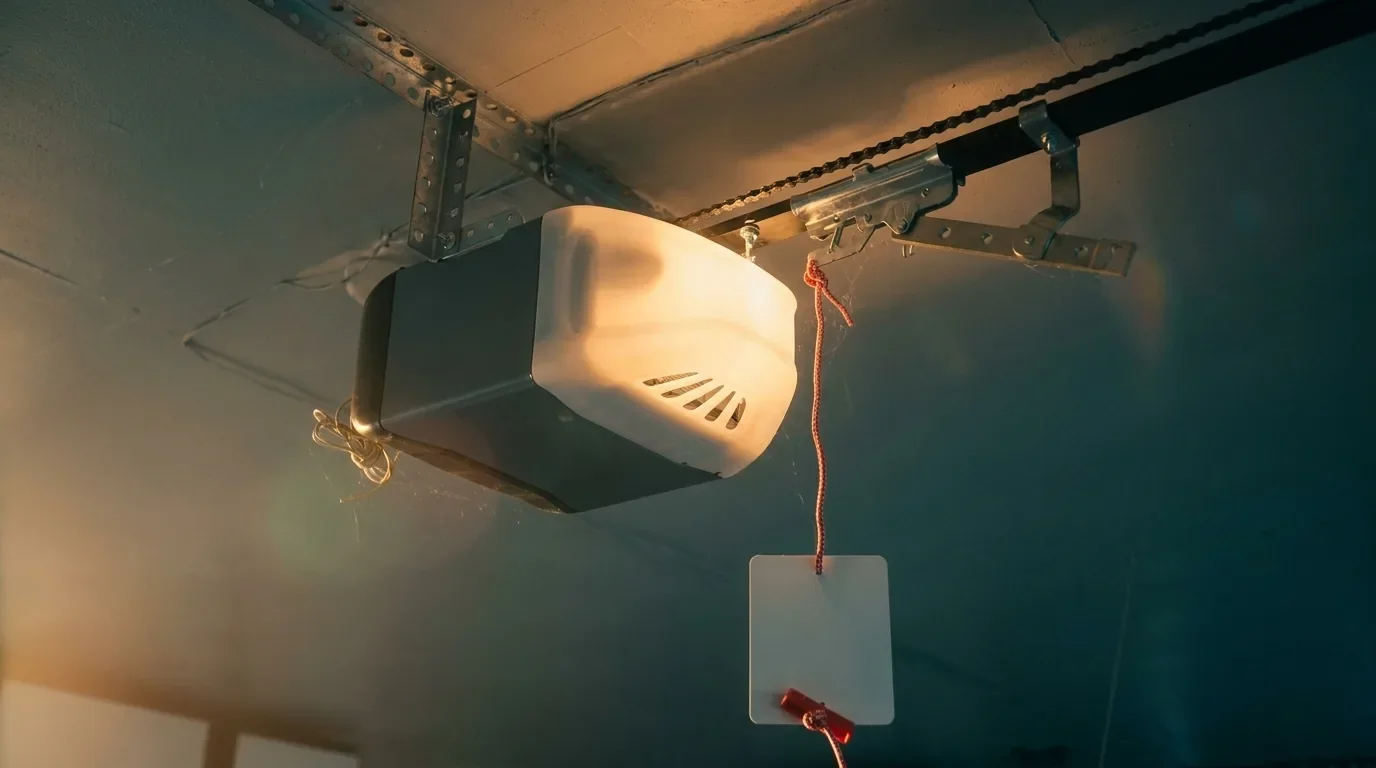
The drive is simply how the motor's rotation gets turned into a straight pull along the rail. There are three common ways of doing it.
- Chain. A roller chain, like a bicycle chain, running along the rail over a sprocket. Cheap, strong, tolerant, and metal against metal.
- Belt. A reinforced rubber toothed belt, usually with steel or Kevlar cords through it, running over a toothed pulley. Same geometry, different material.
- Screw. A threaded steel rod that the carriage travels along. Fewer moving parts, distinctive slow whir, less common now.
Why a belt is quieter, precisely
Not because rubber is soft, or not mainly. Two mechanisms matter.
Impact noise. A chain engages the sprocket one link at a time, and each engagement is a small metal-on-metal impact. Thousands of them a minute, at a frequency your ear is very good at hearing. A toothed belt engages progressively over a rubber face, so there is no impact to hear.
Structure-borne transmission. This is the bigger one and the one nobody mentions. A chain is a rigid metal path from the motor straight into the steel rail, and the rail is lag-bolted to the ceiling framing, which is the floor of the room above. You are not hearing the chain through the air. You are hearing it through the joists, which is why closing the bedroom door does nothing. Rubber breaks that path.
That second point is the whole reason a belt is worth money in a house with a room over the garage, and the whole reason it is nearly pointless on a detached garage at the end of the drive.
The uncomfortable part
Here is what we find on a large share of quiet-opener calls: the opener was never the loudest thing in the room.
Ten rollers with no bearings, skidding in a steel track bolted to the same joists, will comfortably out-shout a chain drive. So will one dry end bearing chirping once per revolution, or a hinge that has worn oval, or a section joint that bangs at the same point in the curve every time.
Replace the opener and you have removed one noise source and left four. This is the single most common disappointed customer in the opener business, and it is avoidable with about ten minutes of listening.
A rough guide by ear: a rhythmic clatter that tracks the motor is drive noise. A scrape or squeal that changes pitch with the speed of the door is rollers. A single bang at the same point every cycle is a hinge or a track joint. A grinding from the motor head itself is usually a worn drive gear, which is a repair rather than a replacement.
What else is different, besides noise
- Lifespan. A good chain will outlast a good belt in raw terms, and it does not mind heat. Sacramento garages get genuinely hot in August, and heat is what ages rubber. Modern belts are made for it; it is still the one real argument for chain on an uninsulated garage.
- Heavy doors. Chain is more tolerant of a door that is a bit over-weight, which is not a virtue. A door that is over-weight should be re-sprung, not dragged.
- Maintenance. A chain wants tension checked and light lubrication. A belt wants tension checked and nothing else.
- Cost. Belt is the more expensive unit, consistently, at every level of the range.
The money question
We will not print prices, and here it is genuinely unhelpful to, because the drive type is one of about four things that set the price of an opener and it is not the biggest.
What moves an opener quote, in rough order: horsepower class and whether the door needs it, the drive, whether it has a battery backup, whether it is a wall-mount unit rather than a ceiling one, and what the installation involves. That last one is the wildcard. An opener going onto an existing header with existing wiring and existing photo eyes is a straightforward swap. One that needs a new header brace, a new outlet, or new safety sensor runs is a different job.
The one place a belt is unambiguously worth the difference is the room-above-the-garage case. If nobody sleeps or works over that ceiling, the money is better spent on rollers and a spring check, and it is not close.
What not to buy
- Do not buy an opener to fix a noisy door. Have the door assessed first. If the rollers are dead you will hear them just as clearly through a quiet motor.
- Do not buy more horsepower than the door needs. A bigger motor does not make a heavy door lighter. It makes it more likely that something else gives way before the opener notices.
- Do not buy a belt for a detached garage on noise grounds. There is no structure to transmit into. Buy the chain and put the difference into the door.
- Do not replace an opener for a worn drive gear. The gear and sprocket kit is a standard, inexpensive part on the common models, and it is the single most frequently mis-sold repair we see.
The short version
Belt drives are quieter because they break the metal path from the motor to your joists. That matters enormously if there is a bedroom above, and very little if there is not.
And a fair number of the quiet-opener calls we take end with a set of rollers and no new opener at all, which is a considerably smaller invoice. We have learned to say it early rather than at the end.
Star Garage Door Repair · (833) 368-3891 · garagerepairstar.com
Lic. 1142048 · Serving Sacramento and the surrounding area.